
The fish stocks of occupied Western Sahara have not only attracted the interest of the Moroccan fleet: other foreign interests are also fishing in the occupied waters through arrangements with Moroccan counterparts. Along the Western Saharan coastline, a processing industry has emerged.

It is almost impossible to overstate Western Sahara's importance to Morocco's fishing sector. As can be deduced from the Moroccan government's data, the Western Saharan coastal area accounted for over 73% of the quantity of Morocco’s annual coastal and artisanal catches in 2024. In terms of value, the catch from Western Sahara’s coastal waters accounted for 61.5% of Morocco’s national total for that same year.
The European Union’s fleet operated in the occupied waters through an illegal bilateral fisheries agreement with Morocco. In 2018, the Court of Justice of the European Union struck down the application of the agreement to Western Sahara, as Morocco has no sovereignty or jurisdiction over the waters adjacent to the territory. The EU institutions ignored the judgment and continued the practice, only this time referring to Western Sahara explicitly as part of the deal’s scope. This amended agreement was again nullified by the General Chamber of the EU Court in September 2021, as it had failed to obtain the consent of the people of Western Sahara through their representative body, the Polisario Front. On 4 October 2024, the CJEU dismissed the appeals lodged by the EU Council and Commission and definitively confirmed that the EU-Morocco fisheries and trade agreements cannot be applied to Western Sahara without the consent of the people of the territory.
The controversial fisheries cooperation between the EU and Morocco dates back to 1988, as Spain acceded to the EU. In 1975, upon abandoning its colony, Spain had made a deal with Morocco whereby it allowed Morocco to occupy Western Sahara in return for fishing opportunities. As part of the financial compensation to Morocco for access to the fish stocks of Morocco and Western Sahara, the EU is funding the development of the Moroccan fishing sector. Most of that sectoral support has been used to build fisheries infrastructure on occupied land, with the EU’s approval. The EU is in this way funding housing for settlers, port infrastructure, freezing halls, energy and technology in the part of Western Sahara that Morocco holds under military occupation.
Most of the EU's fishing under the agreement is carried out in Western Sahara. An independent evaluation ordered by the EU Commission revealed that industrial pelagic trawling on stocks in the territory accounted for 92% of the total weight of all catches made under the 2014-2018 Protocol. An independent evaluation of the 2019–2023 Protocol found that 99% of all catches made by the EU fleet under the agreement consisted of small pelagic species taken by industrial vessels operating under “category 6” fishing activities - a fishery conducted exclusively in the waters of occupied Western Sahara.
The people of Western Sahara have always spoken out against the EU's fisheries in their territory. And they’re not alone. Author of the UN Legal Opinion on the exploitation of Western Sahara’s resources Hans Corell has time and again condemned the EU’s misuse of his text. Former UN Special Representative for Western Sahara Francesco Bastagli has denounced the EU’s practice as a violation of international commitments.

Russian trawlers have been fishing in Western Sahara under the Russia-Morocco fisheries agreement since 1992 – around 10 Russian trawlers are allowed an annually reviewed quota, averaging around 140,000 tonnes. Japan’s first cooperation agreement with Morocco was the fisheries agreement of 1985. Ever since, Japanese vessels have obtained permits to fish tuna and bonito, and have offered financial and technical support to Morocco, which has used this for the development of the fishing sector in Western Sahara.
Shipped elsewhere
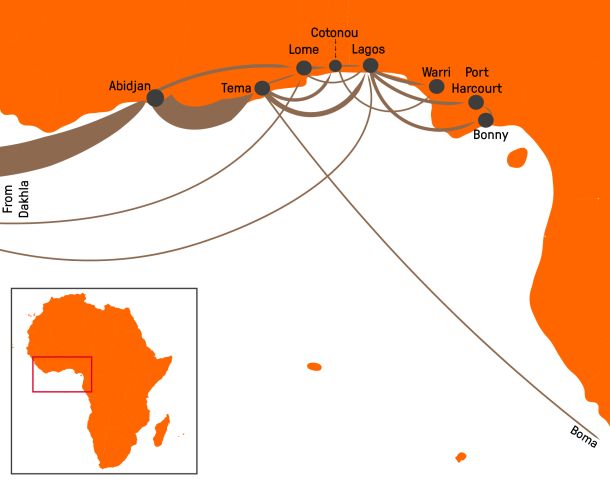
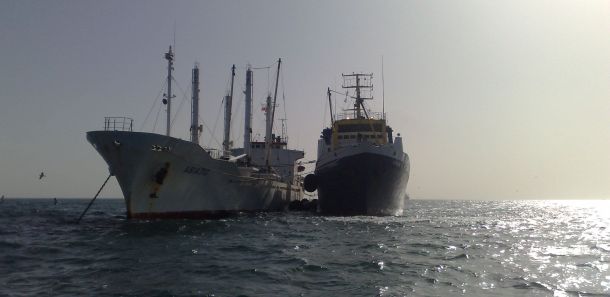
Large quantities of the fish caught offshore Western Sahara are not landed locally. Instead, so-called reefers - refrigerated cargo ships - anchor up next to large fishing vessels just offshore the fishing town of Dakhla. A single reefer can take in as much as 5,000 tonnes of fish. Then, the cargo is transported mainly to markets in West African states.
To compare: the Saharawi refugee camps, that host half of the people of Western Sahara, used to receive an annual 900 tonnes of canned fish in humanitarian aid, until that practice was stopped for financial reasons.
One of the reefer companies, Green Reefers from Norway, has received particular attention. In 2019, one of the company’s vessels came close to being arrested in South Africa, which had also sent out an arrest warrant for the vessel to its neighbouring countries. The vessel planned to transport Western Sahara fish, caught by the Russian fleet offshore the occupied territory, into South Africa.
A substantial volume of fish ends up frozen directly in Spain. The octopus at the Spanish market is to a large extent caught off Dakhla. The frozen fish sector in Western Sahara is bigger than in Morocco proper. In 2024, 122 out of the 212 fish freezing companies operating in Morocco, were actually established in occupied Western Sahara.
Processing industry: fish oil and fishmeal
The port of Bremen is the EU’s gateway to the fishmeal industry in occupied Western Sahara. The importer, Köster Marine Proteins, is the largest fishmeal dealer in Europe and uses the Hansakai port facility owned by J. Müller – described as the “biggest and the most modern fishmeal terminal in Europe”. The fishmeal can be loaded onto ships, trains or trucks in containers or big sacks after customs clearance. WSRW estimates that the Bremen imports could account for approximately 12% of the value of all fishery products exported annually from the occupied Western Sahara to the EU.
WSRW launched a report on the trade in December 2020.
WSRW has uncovered that the value of the fishmeal trade to Turkey is one of Morocco's largest revenues in the entire plunder of the territory. In 2021, 17 shipments were made to Turkey, transporting over 50,500 tonnes of fishmeal. The value of this conservative estimate could be around 64 million USD alone in 2021. The exports in 2019 were probably larger, our assessments show.
In 2019, two tankers delivered fish oil from occupied Western Sahara to the port of Rotterdam, constituting the first such delivery since January 2017, when the Key Bay tanker offloaded its fish oil cargo in France. The probable importer there, Olvea, has never responded to any questions on the matter from civil society groups or media. It has not yet been established which European company is taking in the shipments in the Netherlands. Up to 2010, the leading importer of fish oil from occupied Western Sahara was the Norwegian company GC Rieber. The trade, which had been ongoing for a decade, stopped after Scandinavian media had documented the magnitude of the imports. GC Rieber imported fish oil directly from Western Sahara, but also through its refinery in Tan Tan where fish from the occupied territory was refined. The Norwegian government ordered the company to pay €1,2 million as a rather symbolic amount of non-paid customs for declaring the Western Sahara fish products as Moroccan upon entering Norway.
In 2024, 13 out of the 27 fish oil and fishmeal producers operating in Morocco, were actually established in occupied Western Sahara. Moroccan producers in the territory are able to obtain certificates of alleged responsible fisheries practices, such as from Friend of the Sea and MarinTrust. WSRW published in 2025 a report on the erroneous certificates issued in the territory.
Aquaculture and oyster farming
Aquaculture has become an increasingly important part of Morocco’s exploitation of occupied Western Sahara, particularly around the city of Dakhla, where large-scale oyster farming operations have rapidly expanded over the past decade. Presented by Moroccan authorities as a pillar of the country’s “blue economy” strategy, the sector has attracted substantial state support and private investment.
Moroccan government data show that by 2024, approximately 88% of all oysters produced in Morocco originated from Dakhla. Production in the territory increased from 370 tonnes in 2019 to 1,032 tonnes in 2024, nearly tripling in five years and almost doubling between 2022 and 2024 alone.
Unsustainable fisheries practice
Despite longstanding warnings about overfishing in the waters off Western Sahara, exploitation of the territory’s fish stocks has continued at an unsustainable pace. Moroccan fleets remain highly active in the area, including vessels acquired from former European operators, as was documented in the 2014 “Exporting Exploitation” report by Greenpeace in collaboration with WSRW. Recent scientific assessments have continued to document severe pressure on key stocks. The 2021, 2022 and 2023 reports of the Joint Scientific Committee under the EU-Morocco Fisheries Partnership Agreement concluded that most commercially targeted species in the southern fishing zone - corresponding largely to occupied Western Sahara - are fully exploited or overexploited. Small pelagic fisheries, which account for nearly all catches made by the EU fleet under the agreement, remain under particular stress, with scientific bodies noting historically low biomass levels for sardine stocks.
Large-scale unregulated fishing takes place in Western Sahara's maritime border area with Mauritania. WSRW often observes vessels that are permitted to fish in Mauritanian waters, cross the maritime border with Western Sahara to fish. All kinds of nationalities are involved: EU-flagged vessels, but also vessels flying Chinese, Georgian, Cameroonian, Turkish, Belize flag.

Africa main importer of frozen Saharawi fish
Western Sahara Resource Watch for the first time presents an overview of the transports of frozen fish from occupied Western Sahara. Near all of it ends up in West African harbours.
Belgian-Dutch shipping company caught red-handed in occupied Sahara
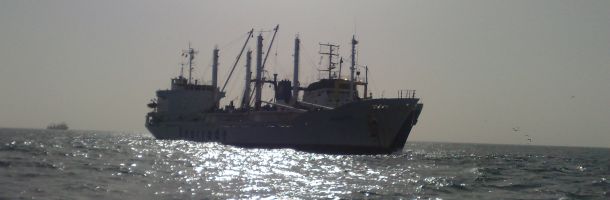
Shipping company Seatrade has again sent a vessel to transport frozen fish out of occupied Western Sahara.
GMP+ does not check if “sustainable” fish is legally caught
The world’s largest certification scheme for “safe and sustainable animal feed” does not check whether its certified fish feed companies source from illegal fisheries in occupied Western Sahara, where catches violate the Saharawi people’s right to self-determination.
Skretting Turkey misled about sustainability
Dutch-Norwegian fish feed giant admits using conflict fishmeal from occupied Western Sahara. Yesterday, it removed a fake sustainability claim from its website.